By Crispin Oduobuk
There is a particular risk with books that emerge from large development programmes. They can become archives of activity rather than reflections of meaning. In other words, long on process and short on insight.
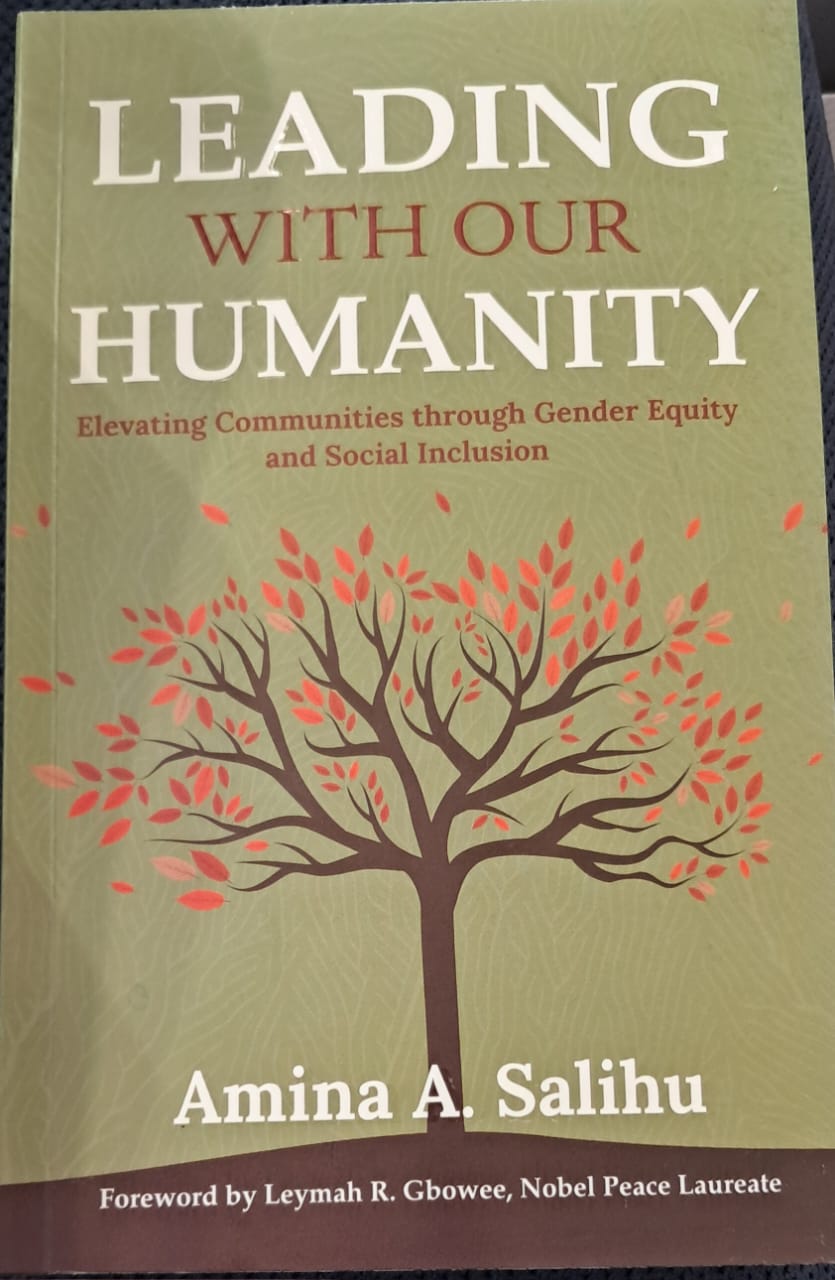
Clearly, Leading with Our Humanity brilliantly avoids that trap. What Amina A. Salihu has accomplished is something more useful: a practitioner’s attempt to make sense of power, responsibility, and learning in the middle of real work, not after the fact.
The author is well equipped for the task: Feminist, farmer, development worker, philanthropist, activist and policy wonk with more than three decades of experience in the transparency, participation and accountability space.
The book draws from all of this experience even though it focuses on the MacArthur Foundation’s On Nigeria Programme, particularly its latter shift toward a Gender Equity and Social Inclusion (GESI) framework. That is the formal frame. Beneath it sits a more persistent question, one that runs quietly through the chapters: what does it actually mean to do justice in a system that is not naturally inclined toward it?
It is instructive that Salihu’s answer is neither abstract nor grandiose. It is simply operational.
Salihu breaks GESI down into three working parts: a value, an approach, and a set of outcomes. It sounds simple, yes, but in practice it is doing a lot of heavy lifting.
By insisting that inclusion must shape internal behaviour, programme design, and measurable results, she pushes against the familiar tendency to treat equity as an external obligation rather than an internal discipline. In that sense, the book is less a manifesto and more a working manual offered as a personal reflection.
One of its more useful contributions is the insistence on equity over equality. This is not rhetorical positioning. It becomes a practical lens for decision-making, from grant design to stakeholder engagement. The distinction matters in contexts like Nigeria, where disadvantage is layered and rarely uniform. Treating everyone the same, as the book repeatedly suggests, is often the fastest way to reproduce the very inequalities programmes claim to address.
With this understanding, it is not happenstance that the discussion of grant making is where the book becomes most concrete. The cohort approach, in particular, stands out. Bringing organisations together before funding decisions are finalised, and asking them to co-develop a shared logic of change, is not standard donor behaviour. It trades speed for depth and control for collaboration. The benefits are clear in the examples provided, especially where collective action reduces individual exposure to risk. The trade-offs are also real, and to the book’s credit, they are not entirely glossed over.
As Salihu notes in the conclusion of Chapter Nine, Catalyzing Collaboration: Lessons from the On Nigeria Program, “Collaboration creates a collective safety net. When people organize and act together, no single individual can be easily isolated, targeted, or harassed. Shared action also serves as a check on state overreach, as the prospect of collective resistance and public scrutiny raises the cost of repression and protects civic actors” (Salihu, 2026, Chapter Nine, p. 88).
There is also an important shift in how success is framed. The move from attribution to contribution may sound like semantics, but it challenges a deeply embedded incentive structure in development practice.
Organisations are wired to claim credit. Funding systems often demand it. Reframing impact as shared rather than owned requires a different kind of discipline, and perhaps a different kind of patience.
The book is at its strongest when it steps out of institutional language and into lived experience. The chapters on caregivers and sign language interpreters, for instance, move the conversation from policy to proximity. They reveal how exclusion operates in ordinary spaces, through time, visibility, and dignity. The inclusion of practical tools, such as guidelines for engaging interpreters, reinforces the broader argument that inclusion is not theoretical. It is logistical.
Another area where the book adds value is in its treatment of exit. Development programmes end, often abruptly, and not always gracefully. Salihu’s emphasis on responsible exit, early communication, and institutional strengthening is a useful reminder that how programmes close can matter as much as how they run.
It is also, in practical terms, one of the areas where trust is either consolidated or quietly eroded. As Salihu writes in her discussion of programme closure, “In GESI work, exiting responsibly is a continuation of inclusion, care, and accountability, an affirmation that dignity does not end when funding does” (Salihu, 2026, Chapter Six, p. 57).
That said, the book is not without its limits.
At times, the institutional voice lingers longer than necessary. Some sections read like extended programme reporting, and a tighter editorial hand could have sharpened the narrative without losing substance. There are also areas where the harder questions are acknowledged but not fully pursued. The constraints around legally sensitive categories, for example, are real, but they leave open the question of how far a framework like GESI can stretch in restrictive environments.
Similarly, while the book does make an effort to name gaps, including social categories that were not fully engaged, the overall tone leans more toward reflection than interrogation. A slightly deeper dive into failure, not just constraint, would have strengthened the argument.
Still, these are questions of emphasis, not direction.
For organisations working in accountability and governance, the relevance of Salihu’s work cannot be overstated. The book does not prescribe a model to be copied wholesale. Instead, it offers a set of practices that can be adapted: embedding inclusion in internal systems, designing programmes with those closest to the problem, treating partners as collaborators rather than contractors, and paying attention to the often-overlooked details that determine whether inclusion is real or performative.
In the end, Leading with Our Humanity is not trying to be definitive. It is trying to be informative and useful. It documents an attempt to align values with practice in a space where that alignment is often assumed rather than demonstrated.
That, in itself, is worthy of commendation, and worth paying attention to.
This is particularly so because the work it describes is ongoing. The questions it raises are not settled. But it leaves behind something practical: a clearer sense that inclusion, if taken seriously, is less about intention and more about design, behaviour, and follow-through.
As Salihu herself acknowledges in her summary of lessons, “Viewing learning as a value means your job is never done. We will never know it all. However, asking the right questions is a fundamental way to stay alert, remain agile, and keep complacency at bay” (Salihu, 2026, Chapter Twenty, p. 238).
And that, it has to be said, is where the real work usually begins.
Moreover, and perhaps more importantly, the book reminds the reader that the real test of any framework is not how well it reads, but how well it holds under pressure, in rooms where trade-offs are real and choices have consequences.
If Leading with Our Humanity does anything enduring, it is to nudge practitioners in that direction: away from comfort, towards clarity, and from rhetoric to responsibility.
In that insistence lies its most lasting contribution, and arguably its most hopeful promise.
Crispin Oduobuk is Snr Programme Officer, Policy & Advocacy at the African Centre for Media & Information Literacy (AFRICMIL).